Cynthia Browne is a Research Scholar at the Max Planck Institute for History of Science, where she currently leads the working group “Troubling Exposure.” The group, as well as Browne’s research, examines exposure as a documentary practice that has been foundational to certain forms of environmental knowledge, as well as integral to counter-documentary practices that work to disclose how trajectories of environmental exposure intersect with legacies and infrastructures of colonialism and racial privilege.
Emily Brownell is a Senior Lecturer in Environmental History at the University of Edinburgh. Her current project, Stories from the Substrate, considers 20th Century East African history through a variety of interventions with, and extractions from, the soil.
Amiel Bize is an Assistant Professor of Anthropology at Cornell University whose research focuses on social and economic transformations at capitalist margins. Her current book project, The Post-Agrarian Question, considers how people make value, in material and meaningful ways, in rural East Africa. She has also published on practices of “gleaning” (claiming the right to leftovers) and is beginning new research on green finance.
Seth Denizen is a researcher and design practitioner trained in landscape architecture, evolutionary biology, and human geography. His published work is multidisciplinary, addressing art and design, soil science, urban geography and agriculture. He is currently an Assistant Professor at the Sam Fox School of Design and Visual Arts and his book with Montserrat Bonvehi-Rosich, Thinking through Soil: wastewater agriculture in the Mezquital Valley came out with Harvard Design Press in the spring of 2025.
Dotan Halevy is an environmental historian of the modern Middle East and a senior lecturer at the department of Middle Eastern and African history at Tel Aviv University. His current research project, Settling Sands: Commodification, Displacement, and the Modern Coastline 1900-1970, explores how the Eastern Mediterranean coastal plain, sparsely populated for centuries, emerged in the modern period as an aggressive frontier of economic and political expansion.
Basil Ibrahim is an independent researcher and writer based in Ithaca, New York. His research explores the political life of voluntary associations, in particular the mobilization and sustenance of collectives as a mechanism for social and economic insurance. He works historically and ethnographically and has collaborated with Amiel Bize on several projects including: a multifaceted project around public services under a regime of permanent austerity, focused on a lower-middle class Nairobi housing estate; and research on rural life in East Africa.
Brian Jones is a historian and web developer who has worked on a broad array of digital projects including The Public Domain Review, The Appendix, and history of local music in Austin, Texas. You can find out more about his work at https://brianjon.es/.
Paul Kurek is a Postdoc in the Society of Fellows and an Assistant Professor of German at the University of Michigan. His current book project, Heavy Load-Bearing Modernity: A Cultural Geology of Albert Speer’s Berlin/Germania, unpacks the intellectual and material history of the so-called heavy load-bearing cylinder, arguably history’s heaviest memorial.
Johannes Lehmann is the Liberty Hyde Bailey Professor of Soil Biogeochemistry at Cornell University. His research focuses on nano-scale investigations of soil organic matter, the biogeochemistry of pyrogenic carbon, sustainable soil management, climate change, biochar systems and the circular economy. He is a member of the U.S. National Academy of Sciences and the German National Academy of Sciences (Leopoldina), and serves as Associate Editor for the Proceedings of the National Academy of Sciences.
Tamar Novick is Assistant Professor of the History of Technology at the Technical University of Munich. Her research lies at the intersection of the history of technology, environmental history, and Middle East studies. She is the author of Milk and Honey: Technologies of Plenty in the Making of a Holy Land (MIT Press, 2023), and her current research focuses on meanings and uses of bodily waste.
Jayson Maurice Porter is an assistant professor of history at the University of Maryland, College Park where he teaches environmental histories of Mexico, the African Diaspora, oilseed crops, and agrochemicals. He serves as a Black and Indigenous Climate Faculty Fellow at UMD’s Indigenous Futures Lab, a board member of Rutgers University’s Black Ecologies Lab, and a co-designer of the Chicago Teachers Union’s Environmental Justice Freedom School.
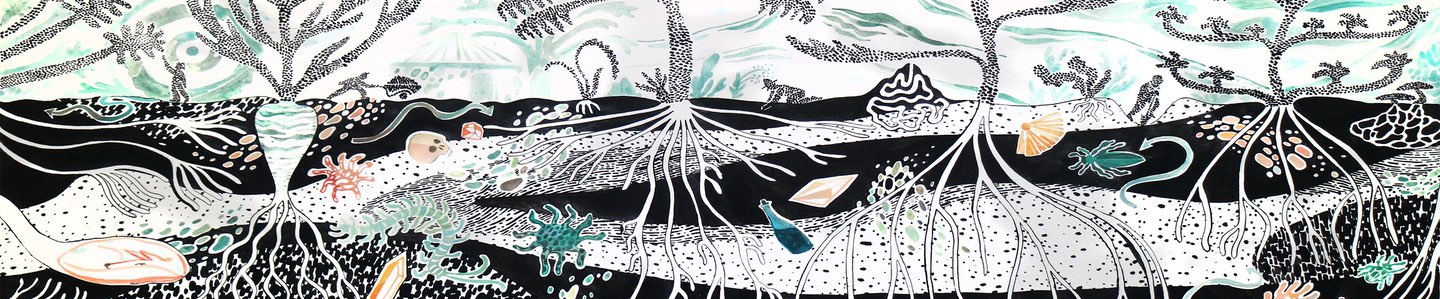
Natasha Russell is an artist and illustrator based in Edinburgh, Scotland. Her work is usually developed in collaboration with communities, researchers or organisations in order to visualise their ideas and to explore connections between people and their surrounding environments. Often, these projects are developed in response to a particular location or environment and take the form of murals, ink drawings and linocuts. You can see her work at https://www.natasharussell.com/.
Steven Stoll is Professor of History at Fordham University. He is the author of Ramp Hollow: The Ordeal of Appalachia (2017). He is writing “A Word For Land: How We Relate in the Spaces We Create”, to be published by Yale University Press.
Lulu Tessua is a PhD student at the University of Nairobi where she is pursuing her PhD in Anthropology. Her current research is on the afterlives of Ndungu Agricultural Project in Kilimanjaro, Tanzania, with a major focus on pesticide use and its effects on health and environment.