
Appalachia, USA:
Mountains Become Wasteland
Essay
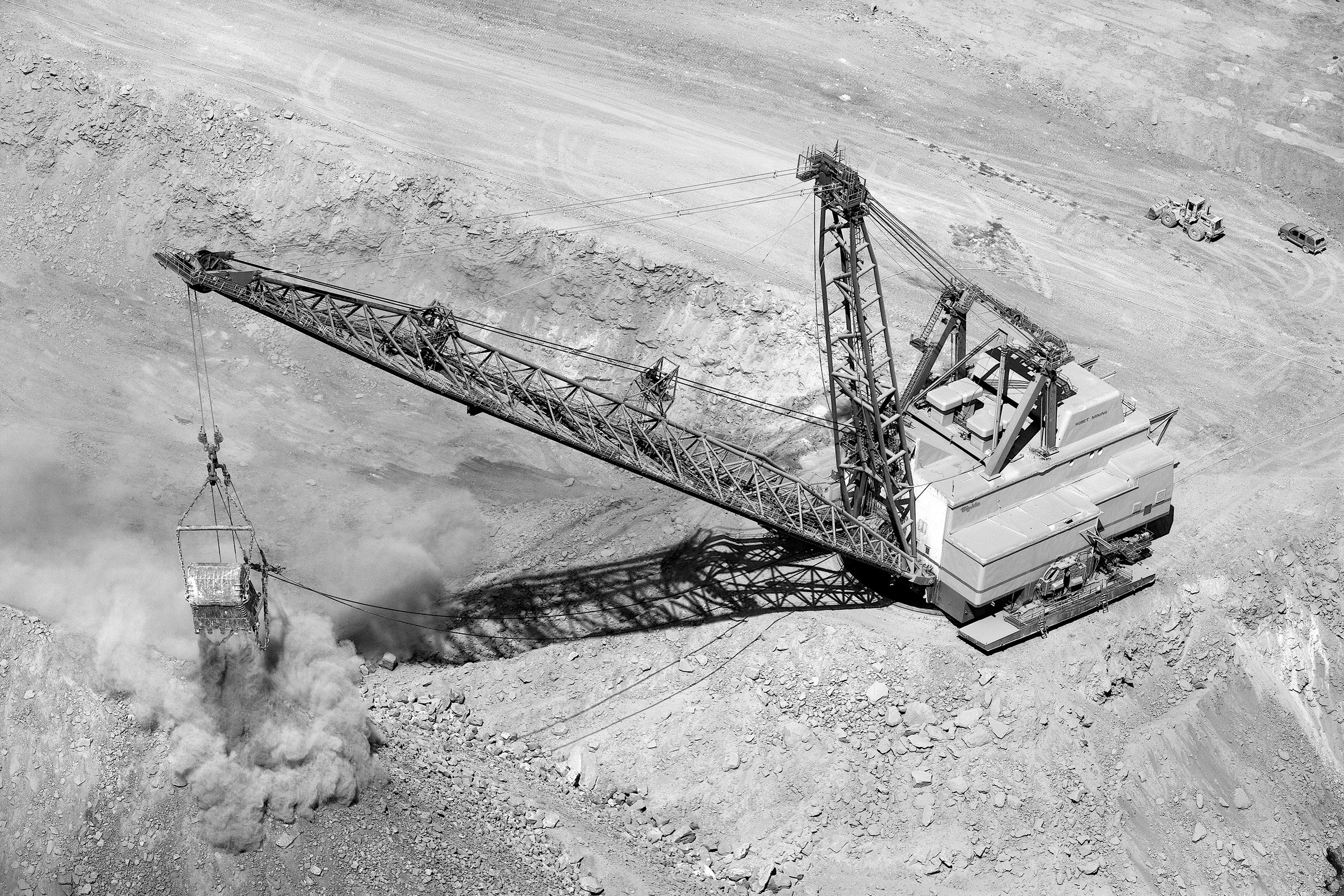
Figure 1. A dragline in southern West Virginia, 2010. Note the size of the bulldozer and truck in comparison. Photo by Mark’s Photo, under licence from Getty Images.
On a spring morning in 1966, a retired coal miner named Ellis Bailey awoke to a rockslide that crushed part of his house, engulfed his car, wrecked his garden and polluted the spring that provided drinking water to his family and cattle. The debris fell from a strip mine 600 feet above his farm on Toney Fork, near the town of Clear Creek in Raleigh County, West Virginia.
In Before the Mountain Was Moved (1970), Bailey and his family recreate that day for filmmaker Robert Sharpe, using a pickaxe against the muddy spoil that still trapped their car a year after the event. At 66 years old, living on $94 a month, he resents that coal mining first ruined his lungs, then ruined his farm and those of his neighbours. ‘Whole towns gets covered up’, says Bailey in the film, ‘whole roads gets blocked, whole rivers dammed up. There’s no way that I see to stop it. It’s a barren land left worthless.’1
It begins by clear-cutting and burning the forested landscape. Bulldozers cut a horizontal shelf or bench into the slope where workers pile a series of spoil banks, long berms or ridges of torn-away earth. Then they build the dragline excavator: a colossal walking crane-like machine, 200 feet tall, weighing 10,000 tons, with a bucket that can bite and lug 100 cubic yards of earth, equivalent to the volume of two and a half forty-foot shipping containers. The dragline disgorges this overburden into the adjacent hollows, their ferny creeks and shrubby glades never to be seen again.
The burdens extend well beyond the process of ‘valley fill’, shooting fissures from the substrate into communities. Blasting sends out shockwaves that can crack the foundations of houses. The constant boom and rumble cause anxiety. Clouds from explosions envelop communities in fine dust and chemicals. Rainwater laden with acid, a chemical reaction of sulphur-bearing minerals exposed to oxygen, seeps out of the bottom of entombed hollows into watersheds, turning rivers a burnt shade of orange, killing fish and birds. ‘Just a few months ago there were crawfish here, and now there’s not a minnow’, says one of Bailey’s neighbours, ‘There’s not a living thing in this here creek whatever.’ Debris tumbles down creeks, causing flooding. A torrent of boulders came smashing into a woman’s yard. She asked a mine worker who would come to remove it and repair the damage. ‘He just looked at me and laughed.’2
The coal itself causes suffering and conflict. It requires washing and crushing, which leeches a noxious slurry of heavy metals that companies slough off into putrid pools behind impoundment dams. In February 1972, just such a dam collapsed in Logan County, West Virginia, releasing a thirty-foot-high tsunami of sludge down Buffalo Creek. Moving at seven feet per second, it crushed everything in its path for seventeen miles, killing 125 people. Just as carcinoma can spread beyond its lesions, the lethality of mountaintop removal proliferates from mine to hollow to river, from lungs to brains to the next generation.3
But everyone who lived in the mountains during those years also told another story about land and soil. Toxic sludge and the debris from strip mines were not only deadly but also a moral insult. They not only destroyed life and property but also buried the rural cemeteries found all over Appalachia. Community burial grounds hold the bodies of ancestors. Headstones record the bare details of lives so that loved ones might not be forgotten. Soil not only fed and employed them but also represented their tenuous hold on the landscape and their final places of rest. Between 1967 and 1977, citizens in southern West Virginia asserted that no amount of money justified the destruction of their homes and cemeteries by flyrock, blasting and toxicity. A working-class coalition of Black and White activists challenged the acquiescence to power that strip mining stood upon. They challenged the strange economy that turned the places they held sacred into waste.
Waste comes from Latin (vāstum) by way of Old French and arrived in English by the thirteenth century for places wild, desolate, uncultivated and uninhabited. This sense was most prevalent in England, where lying in waste doesn’t describe the uselessness of land but only whether it can be cultivated or improved. A waste might be terrific for hunting, foraging and extensive livestock grazing, uses considered inferior by lords but beloved by peasants. The mountains of Appalachia had always been waste in this sense: The land is impossible to cultivate by the standard of commercial agriculture, but productive and invaluable for the wild foods and other gifts it provided.
Over the centuries, a word for something needless or superfluous (fourteenth century) developed into something thrown out or eliminated as worthless (seventeenth century), then denoted an organism’s excreta (nineteenth century). Industrialisation introduced wastewater, waste collector and waste heap, along with waste place, a neglected or abandoned site. Wasteland is more complicated. For a long time, it appeared as two words for waste in the old English sense. It took on a sense of purposeful ruin after 1900, most notably in T.S. Eliot’s 1922 poem The Waste Land. The term became commonplace. A story in The Reader’s Digest from 1938 mentions New Jersey as ‘a happy hunting ground for industrialists seeking to dodge strict regulatory laws … an industrial wasteland inhabited by immigrants’.4
Like organisms, systems produce waste. Frogs eat crickets; draglines consume diesel fuel. Both convert high-order matter into energy, expelling low-order leftover. But frogs and draglines differ in every other way. The energy that powers any technology comes from people interacting with each other and the environment through institutions. There’s no better example than coal mining, which requires bankers, corporate managers, workers, politicians and engineers, all brought together to remove a black mineral from deep under the earth. Energy is a social product, not something that comes from the environment as we find it and experience it. And while the environment immediately absorbs a frog’s waste, the waste from coal mining generally and the dragline in particular includes chemicals and metals that must be impounded to prevent them from entering rivers and streams where they kill fish and birds.5
Beginning in the 1830s, when coal-burning engines overtook waterpower as the prime mover in English manufacturing, the offloading of waste onto society emerged as one of the essential premises of industrial capitalism. No company could internalise smoke, soot, slag and ash, and none considered it. Owners and managers began to regard waste in all its forms as the unavoidable consequence of what they called a civilisational necessity. ‘When systems are dominant’, explain Liboiron and Lepawsky, ‘what they devalue and discard becomes widespread, normalised, and systematic even when some people do not want to participate in those systems.’6
For a century before the Civil War, eastern elites bought up hundreds of thousands of acres in the highland counties of Pennsylvania, Virginia, Kentucky and Tennessee, mostly for speculation. The people who lived in the mountains hunted, foraged and gardened at will on endless realms of wooded real estate, regarding these absentee estates as common property. After the Civil War, joint-stock companies began to buy up the old deeds, using courts to eject tens of thousands of Appalachian households to clear their titles and resell the land to logging and mining companies.
Digging a tunnel into a mountain left the landscape mostly intact. But there was always another method. Surface mining (a general term that includes strip mining and mountaintop removal) also caused little damage. Human labour and the first digging machines could only reach shallow veins, leaving pits in the forest like the craters of tiny meteorites. During the crucial decades of the American Industrial Revolution, armies of men descended into the depths of the earth, breathing coal dust and risking tunnel collapse. Then, after the Second World War, surface mining returned. More powerful machinery made it possible, but the economic motive was more consequential: competition from liquid fossil fuels. Oil requires fewer workers than coal. It can be moved through pipes, without trucks or trains. Its relative cheapness undercut underground mining. Mining companies responded to stagnating profits by using bulldozers and dragline excavators to mechanise nearly every facet of extraction, doubling the productivity of each worker.
Strip mining might be the most striking example of how the commodity form of land can serve as a mechanism for taking control away from communities. In most states, towns and counties write their own zoning ordinances. But several states, including West Virginia, can override any local decision. By issuing strip-mining permits, the state of West Virginia allows corporations to operate almost entirely beyond the control of the people who are most affected. Ravaging the landscape seems like a strange strategy for economic growth, but since its founding during the Civil War, West Virginia has behaved like a developing country, selling off its resources and offering up its residents as labour. Its elected officials could participate in a version of modernity, in which they join the industrial world as its source of industrial power. Seldom, if ever, in human history, except during war, have people faced the intentional annihilation of their environment.
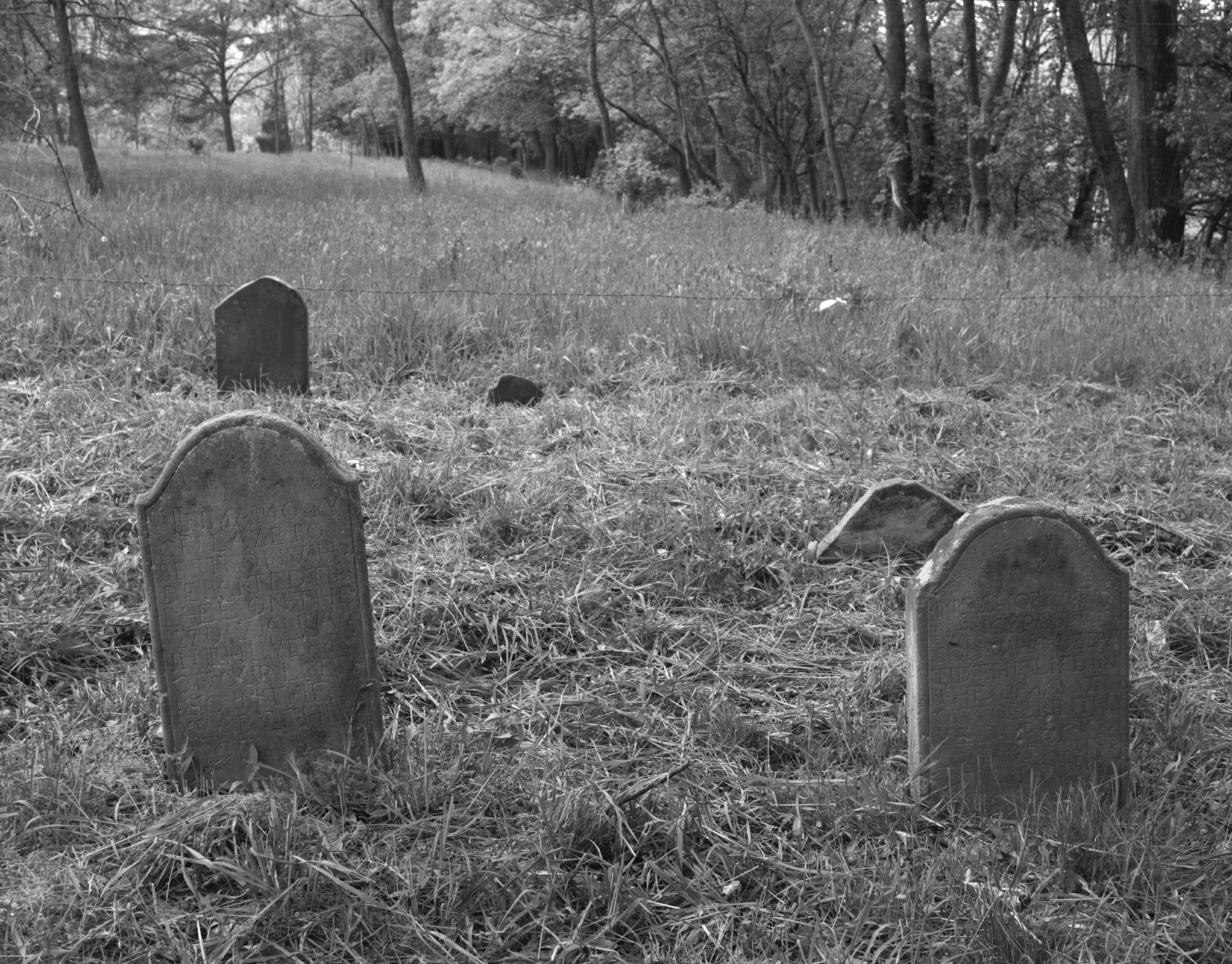
Figure 2. A family cemetery in West Virginia. Strip mining operations often bury these burial grounds in debris. Photo by John Nicely (s.d.), public domain from Library of Congress, Prints & Photographs Division, HABS survey.
Early in the film, Ellis Bailey is buying groceries when he confronts a coal worker named Robert Kincaid. People in town knew that Bailey and a few neighbours were soon driving to Charleston to lobby the state Senate for a law to protect them from damage and poisoning. Kincaid tells Bailey that he won’t change a thing.7
That’s when Bailey mentions the cemetery. Burial and the desecration of graves haunt the film, which opens with Bailey pausing at his parents’ graves. Rural cemeteries are highly vulnerable to destruction by strip mining, lacking legal protection. The only people who guard and maintain them are families and communities, who, if they look away, might find that the only evidence their ancestors ever lived had been dumped on, crushed by machinery or bulldozed away. Bailey wants the same internment his parents had, the community releasing his body to the earth’s embrace, and in a location where his children can visit to remember him. Kincaid says the company can move the cemetery, but Bailey doubts that. ‘I don’t see how you’re going to put a man back in his box and put him in the ground … You may not dig him up, but you’ll cover him up so deep that he’ll never be got at!’
Another Appalachian activist, the attorney Harry Caudill of Kentucky, captures this sense of violation. ‘I lament the utter ruination of the hills of my own homeland and the assault surface mining has made on people of my blood and name … I have seen the shattered roofs, the broken grave-stones.’ (By using homeland to make this claim, Caudill effaces previous indigenous possessors and their graves.) ‘In Knott County, Kentucky’, wrote Caudill, ‘Mrs. Bige Ritchie saw the coffin of her infant son flung up by a bulldozer.’ Both Bailey and Caudill regarded cemeteries as a custom, a hold or limit asserted by a community on the wielding of power, a longstanding folk practice that common people assert as having the force of law, in this case, one insisted upon by the living in their care of their dead. Mountain residents often located burial grounds on the tops of mountains and facing east, ready for the rising sun on Easter morning. They’re not willing to have their dead forklifted out of the way for someone’s convenience, and they consider any disturbance immoral.8
The desecration of cemeteries by strip-mine companies might not be intentional, but it represents a more expansive ideological position – the redemptive power of industry to wipe away the idiosyncrasies of Appalachia. Nothing, says Kincaid, will stop money and modernity, certainly not the Raleigh County Community Action Association (RCCAA), the anti-poverty civil-rights organization to which Bailey belongs.
Kincaid: You think we’re going to move our machinery out of that holler on account of you? No sir, never happen … We ain’t trying to move you; we tried to buy you out and you won’t sell ... We offered you jobs … and you won’t work! ‘No, I got my little farm take care of … My little farm’ – that’s all you study about … ‘My little farm!’
Bailey: My little farm is going to be there when the stripper is gone! …
Kincaid: When you and the Community Action get through, we’re still gonna be stripping coal – understand that buddy!
Kincaid sees Bailey’s sloping pasture along the winding fork as a stubborn remnant, as waste in another sense – misallocated labour, time and land. To the coal companies, it seems, strip mining annihilates the mountains to save them.
Behind Kincaid’s argument is an unequal exchange. This is what happens when the little farm in the hollow, the clear-running creek and the family plot are given up for jobs and economic growth. An unequal exchange cannot be made equal with more money, as though Bailey and his neighbours could have bought a new mountain and installed it where the old one stood. When the landscape becomes a commodity, it can be acquired through the market and dis-embedded from communities, rewarding absentee ownership with profit while those under the dragline live in a diminished environment.9
Bailey and his neighbours drive to the Capitol in Charleston to lobby for a regulatory law. They elect Bailey to address the legislature. ‘I’m not an educated man’, he began,
don’t know how to speak much, but I’m here to state the facts of what’s happening in Raleigh County of West Virginia … I have sixty-five acres of land. This land is almost washed away. The ponds washed full of water, my cattle have nowhere to drink … Our roads are rot in our area, our culverts is filled up, our creek beds is filled up ... Every man should have his own right, but the poor man’s right is being destroyed right today. And the strip mine has done more to destroy the poor class of people than anything that’s ever hit our area.10
After months of advocacy, poor people in counties throughout the state convinced elected officials to pass the West Virginia Surface Mining Act of 1967. On the face of it, they could claim a significant victory. The legislature determined that strip mining ‘destroys or impairs the health, safety, welfare and property rights of the citizens of West Virginia’. The law regulated wastewater and backfilling and further decreed that ‘the Department of Natural Resources is hereby vested with jurisdiction over all aspects of surface mining,’ including ‘restoration and reclamation’. Teams of inspectors would visit every site once a month to ‘note all violations of law’. Citizens had overcome industry resistance and shamed the state into redirecting its agencies for the public good.11
But a year later, when they danced to Bailey’s banjo to reenact their celebration for the end of the film, the citizens of Raleigh County had already lost confidence in the Surface Mining Act. They realised that, while regulation could force coal operators to pile overburden at such and such an angle and plant grass under highwalls like so, it also allowed them to continue blasting mountain after mountain while claiming responsible behavior, offering them the imprimatur of good citizenship. At last, the public had been served. At last, blasting would be illegal within one hundred feet of any home. Yet they hadn’t won much of anything. One hundred feet was still close enough to shatter windows, a sort of metaphor for how regulation can legalise and fortify the thing it claims to control. The reformers realised, in short, that the problem with the surface mining law was surface mining.12
They also knew their victory could not be repeated. Before 1967, stripping operations tended to be owned by small companies that lacked the political sway to stop regulation. Many of these failed after the law’s passage, and likely because of it, forcing them to sell the most valuable thing they owned: their mineral rights. Absentee corporations bought those rights, subsuming at least thirty small coal operators by 1970. They did this in response to oil prices. From 1957 to 1973, crude fell from $34 to $25 a barrel, which lessened profits. At the same time, the price for a ton of bituminous coal increased (modestly), which attracted capital and led to further consolidation. The companies that absorbed local operators were themselves absorbed into the Tennessee Valley Authority, Ford Motor Company, Gulf Oil, Duke Power, Kennecott Copper, and other corporations whose combined land holdings produced forty per cent of the nation’s coal.13
Watching these events and stunned by the toothlessness of reform, a member of the West Virginia Senate introduced a bill to abolish strip mining in January 1970. Lobbyists moved in. They likely spoke privately to legislators the way one explained the industry’s position in print. ‘It is inconceivable to those of us in the industry that the state of West Virginia would be willing to sacrifice economic considerations of this magnitude for the sake of resolving an aesthetic problem.’ They cast the forested landscape as nothing more than scenery atop billions of dollars in fossilised minerals.14
Lawmakers buckled under the threat of unemployment, even though coal companies themselves had eliminated thousands of jobs over the previous thirty years by shifting from underground mining to more profitable mountain removal. Politicians might have felt swayed by the ethos of the times. In the emerging logic of neoliberalism, wreckage and misery in the interest of profit resulted in the greatest social benefit, and corporations began to reject responsibility to anyone other than their shareholders.
When the West Virginia Legislature acted, the bill they passed paused new permits for two years, but only in the 22 counties where strip mining had never existed. In the other 33 counties, the blasting and valley fill didn’t cease. The reformers didn’t stop either; they kicked the issue to Congress. A representative from West Virginia introduced a bill to outlaw strip mining throughout the United States. ‘I can testify’, he told a Senate subcommittee in 1971, ‘that strip mining has ripped the guts out of our mountains … and left a trail of utter despair.’ Six years after the Buffalo Creek disaster, President Jimmy Carter signed the Surface Mining Control and Reclamation Act of 1977. It set standards for impoundment dams, but it protected those exposed to strip mining no better than previous laws.15
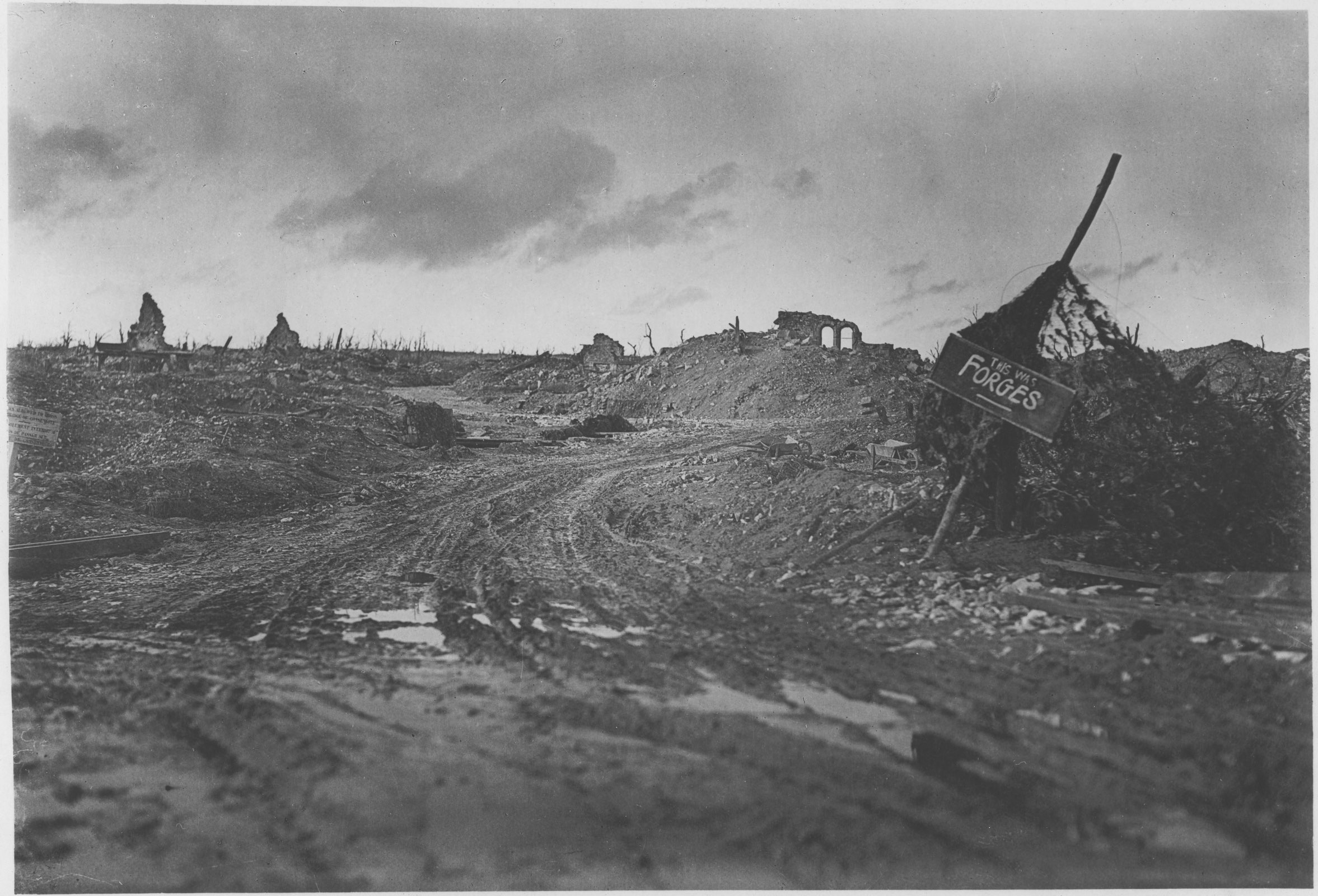
Figure 3. The French countryside turned to wasteland during the First World War. The sign reads, ‘This Was Forges’, referring to Forges-sur-Meuse, site of the final Allied offensive. Photo by Edward Steichen (1918), public domain from Library of Congress, Prints & Photographs Division.
Another term describes the strange sense of displacement caused by strip mining. No-man’s land first appeared in the English Domesday book of 1086 for a location beyond the walls of London reserved for executions. The Western Front of the First World War introduced a new kind of no-man’s land, a zone of obliteration. In the five years between 1914 and 1919, nearly eighteen million soldiers and civilians died. The killing extended to the rural fields that served as fields of battle. Trees stripped to snags, the ground gullied and poisoned. ‘Over the edge of the trench … every wire entanglement an antinomy, every barb a definition, every explosion a thesis’, wrote the philosopher Walter Benjamin. ‘Deeply imbued with its own depravity, technology gave shape to the apocalyptic face of nature and reduced nature to silence.’16
Today, an estimated one million people in Appalachia live under drift clouds in ‘blast communities’, where they drink arsenic and breathe particulate matter. They suffer from cardiovascular disease, kidney failure, chronic lung disease, cancers, congenital disabilities and low birth weight, adding up to 1,200 early deaths every year in the four most affected states (West Virginia, eastern Kentucky, eastern Tennessee and southwestern Virginia), even after controlling for poverty, obesity, smoking and inadequate health insurance.17
A team of researchers measured environmental decline in the same regions. In one example, almost all the streams from underneath valleys filled with overburden reveal selenium concentrations high enough to cause deformities in larval fish and reproductive failure in birds. Algae along the streambeds contained 2,000 times the selenium found in the streams. Strip mining has caused this suffering by devastating an area the size of Vermont and New Hampshire, including 500 mountains blasted and 2,000 miles of river and stream buried, for the unimpressive achievement of generating three per cent of the electricity in the United States.18
West Virginia is already a no-man’s land in a different sense: Between 1950 and 2000, West Virginia lost 10.5 percent of its population. But there is another way to comprehend this decline. Adding up births, deaths, and migration in and out, by 2000 several counties had lost the equivalent of 60 or 70 percent of the people they counted in 1950. McDowell County lost 103 percent, meaning the number of residents who died and left during that half-century was greater than the total in 1950. 19
Coal companies reject the idea that strip mining creates wastelands or no-man’s lands. Every regulatory law enshrines restoration, as though capital and nature can be reconciled by scattering grass seed. The federal government’s early rules and recommendations reveal the absurdity of this policy. A manual from 1968 makes a few suggestions: ‘AIR QUALITY. – Help prevent offensive noises and air contamination by controlling use of explosives, fire, and motorised equipment … NATURAL BEAUTY. – Plan operations so they have a minimum impact on the landscape.’ The conceit of the laws is their argument that things can be put back to how they had been before.20
But putting things back isn’t everyone’s goal. Certain residents don’t see highwalls as ruins but as a kind of topographical improvement. In this view, draglines create blessed flatland, reconfiguring the zigzag of hollows into little simulations of Ohio and Indiana. In 1972, a writer for Coal Age bragged about the shopping centres, car dealerships, drive-in theatres and airports that could only have been built on land rendered ‘far more valuable than it ever was in its undisturbed condition’. As the sociologist Rebecca R. Scott explains, housing developments built on formally stripped land have the look and feel of suburbs in other parts of the country. They appeal to a managerial class looking for an escape from some of the stigma of Appalachia, ‘a way to become more modern, more homogeneously American’.21
In 2013, members of the Jarrell family visited a cemetery in Boone County where their relatives are buried. They needed permission from Alpha Natural Resources, the owner of the Twilight Mine that circumscribes the site. Alpha insisted on a specific date and a flurry of rules: hours of safety training, steel-toed boots and hard hats. After taking intrusive personal information, including social security numbers, company representatives brought the family across a gouged-out canyon to the top of a lone carved-away pillar with a tuft of trees, seemingly suspended in a nowhere that was once the mountain landscape. When they arrived, they found broken headstones.22
The cemetery at the top of the ridge or the bottom of the hollow appears repeatedly in the struggle over strip mining because it represents a violated moral boundary. But it also represents the lack of control residents experience over where they live. When land became a commodity and financial asset, it could be detached from communities. Most Americans embrace private property but often without confronting the contradiction that tormented the people of Raleigh County. They saw that the same freedom to buy and sell a house for all-purpose money allowed distant corporations to gain hold of the landscape and wreck it.
It’s all the worse that, by 1970, geologists and chemists had known for decades that burning fossil fuels releases carbon dioxide that causes the atmosphere to heat. Yet the United States did not act – not then, and not until the passage of the Inflation Reduction Act of 2022. Most states have stopped using coal to generate electricity, but fifteen still produce most of their power that way. By this measure, West Virginia reigns supreme. Ninety per cent of its electricity comes from coal. The people there must know that the day will come when no one any longer will mine or burn it. An infrastructure of the future has to include more than infrastructure, but the ideas that invigorate democracy and environments together. When that happens, the mountains will be quiet again, Clear Creek will run clear again, and the dragline excavators will finally come to a stop, their gargantuan wheels and buckets rusted, stuck, and gaping.
Ellis Bailey died in 1990 at the age of 86. He is buried in the town of Clear Creek.
Notes
- Sharpe 1970. ↵
- Ibid.; Sharpe 1971: 24; Campbell 1970; Montrie 2003: 112; John D. Rockefeller IV quoted in Burns 2007: 200. ↵
- West Virginia University Library 2022. ↵
- Libroiron and Lepawsky 2022: 71; Reader’s Digest 1938: 74. ↵
- This goes for machines powered by solar and wind energy no less than fossil fuels because the mechanism for converting any energy into mechanical power is created and adopted through social relationships of money, exchange, labour, and so on. Hornborg 2023: 17–18. ↵
- Liboiron and Lepawsky 2022: 77. ↵
- The film’s credits list Kincaid as portraying the stripping companies. He is mentioned in an article about the Raleigh County Community Action Association and might have been a member. Sharpe 1971. ↵
- On the cemeteries of Appalachia, see Maples and East 2013. Caudill 1972: 812; Caudill 1971: 142–43. Caudill testified that Ritchie said, ‘I thought my heart would bust in my breast … when I saw the coffins of my children come out of the ground and go over the hill.’ ↵
- Hornborg 2023: 40–44. ↵
- Scott (2010: 174–75) makes a similar point: ‘In the coalfields, property rights are stacked in favor of the corporations; the right of an individual to protect his or her little piece of land is tenuous, downright illusory, if the coal company that owns the hills above decides to alter the topography.’ ↵
- Congress also investigated strip mining. In 1964, Secretary of the Interior Stewart Udall testified before a House committee that in return for sending coal to homes and industry, Appalachia would be trashed. ‘Surface pits … reduce whole drainage basins into a barren wasteland. This, then, is the region’s basic dilemma. The resource which must produce its livelihood and can ensure its future has also been its scourge.’ The Appalachian Regional Development Act of 1965 included the first federal regulations for the restoration of land stripped for coal. Udall quoted in US Congress, House of Representatives 1964: 51–53.↵
- The act is sometimes called the ‘regulatory law’. It has no official title. West Virginia Legislature 1967. ↵
- The Highlands Voice (May 1970 and February 1970). For oil prices, see https://www.macrotrends.net/1369/crude-oil-price-history-chart ↵
- Testimony of Norman Williams reported by the Charleston Gazette (27 Feb. 1971), reprinted in The Highlands Voice (April 1971). Secretary of State John D. Rockefeller IV saw momentum building behind the prohibition bill and decided to support it in his run for governor. ↵
- ‘West Virginia Legislature Halts Move to Abolish Surface Mining’, Coal Age (April 1971); ‘West Virginia Senate Votes Ban on Strip Mining in 36 Counties’, New York Times (7 March 1971). See the testimony of James Branscome in US Congress, Senate 1971: 224–25. Montrie 2003: 122–28, 142. For coal prices, see the US Energy Information Administration, https://www.eia.gov/coal/. The representative who introduced the ban in Congress was Ken Hechler (WV 4th District, 1959–1977). US Congress, Senate 1971: 168, 224–25. ↵
- Davidson 1955: 20–23; Stilgoe 1982: 220–21; Leshem and Pinkerton 2016: 50; Benjamin 1979: 163. Elsewhere, Benjamin (1968) wrote, ‘A generation that had gone to school on a horse-drawn streetcar now stood under the open sky in a countryside in which nothing remained unchanged but the clouds, and beneath these clouds, in a field of force of destructive torrents and explosions, was the tiny, fragile human body’. The 460 square miles of Zone Rouge, including the battlefields of the Somme and Verdun, where the bones of 100,000 soldiers are still unburied, remain so contaminated by unexploded shells and toxins that at the present rate of restoration it will be uninhabitable for another 300 years. ↵
- Tony 2021. ↵
- The number of streams found with selenium was 73 out of 78 tested. The study is a digest of peer-reviewed studies. VF stands for valley fill. Palmer et al. 2010. ↵
- West Virginia Department of Health n.d. ↵
- US Department of Agriculture 1968. ↵
- Scott 2010: 173–79. Richard Kelly, editor of West Virginia Illustrated, quoted in ‘The Greening of West Virginia’, Coal Age 77 (Feb. 1972): 8–88. But this secondary use is often overstated by the industry. Only about 1% of formally stripped land can be used for anything. ↵
- Asbury 2013. ↵
References
- Asbury, Kayla. 2013. ‘Family Says Mountaintop Removal Mine Damaging Cemetery’. West Virginia Record, 4 October.
- Atwood, Genevieve. 1975. ‘The Strip-Mining of Western Coal’. Scientific American 233 (6): 23–29.
- BBC. 1974. American Coal Mining. Video. https://www.youtube.com/watch?v=SyFWtzTa1Go
- Benjamin, Walter. 1968. ‘The Storyteller: Reflections on the Works of Nikolai Leskov’. In Hannah Arendt (ed.) Illuminations: Essays and Reflections. New York: Shocken Books.
- Benjamin, Walter. 1979. ‘Theories of German Fascism: On the Collection of Essays War and Warrior, edited by Ernst Jünger’. New German Critique 17 (Spring): 120–28.
- Burns, Shirley Stewart. 2007. Bringing Down the Mountains: The Impact of Mountaintop Removal on Southern West Virginia Communities. Morgantown: West Virginia University Press.
- Campbell, Jean. 1970. ‘Strip Mining Begins Anew in Clear Fork District’. Beckley Post-Herald/Raleigh Register (14 and 21 June 14).
- Cash, Frank E. 1929. Methods, Costs, and Safety in Stripping and Mining Coal, Copper Ore, Iron Ore, Bauxite, and Pebble Phosphate. Washington, DC: US Department of Commerce, Bureau of Mines.
- Caudill, Harry M. 1972. Statement of Harry M. Caudill. Regulation of Strip Mining: Hearings Before the Subcommittee on Interior and Insular Affairs, US House of Representatives, Ninety-Second Congress, First Session. Washington, DC: US Government Printing Office.
- Caudill, Harry M. 1971. My Land Is Dying. New York: E. P. Dutton.
- Charleston Gazette, Charleston, WV.
- Coal Age. 1960s and 1970s. New York: McGraw-Hill Publishing.
- Davidson, T.D. 1955. The Untilled Field’. Agricultural History Review 3: 20–25.
- Fox, Julia. 1999. ‘Mountaintop Removal in West Virginia: An Environmental Sacrifice Zone’. Organization & Environment 12: 163–83.
- Grim, Elmore C. and Ronald D. Hill. 1972. Surface Mining Methods and Techniques. Washington, DC: Environmental Protection Agency.
- Hendryx, Michael. 2017. ‘The Shocking Danger of Mountaintop Removal—and Why It Must End’. TEDMED. November. https://www.ted.com
- Henn, John J. 1975. Updated Cost Evaluation of Metal and Mineral Recovery Process for Treating Municipal Incinerator Residues. Publication 8691. Washington, DC: US Department of the Interior, Bureau of Mines.
- Highlands Voice. N.d. Charleston, WV. West Virginia Highlands Conservancy.
- Hornborg, Alf. 2023. The Magic of Technology: The Machine as a Transformation of Slavery. New York: Routledge.
- Leshem, Noam and Alasdair Pinkerton. 2016. ‘Re-Inhabiting No-Man’s Land: Genealogies, Political Life and Critical Agendas’. Transactions of the Institute of British Geographers 41 (1): 41–53.
- Liboiron, Max and Josh Lepawsky. 2022. Discard Studies: Wasting, Systems, and Power. Cambridge: MIT Press.
- Lucht, William H. 1971. ‘To Strip or Not to Strip: The Pros and Cons’. Register and Post-Herald (16 January).
- Maples, James N. and Elizabeth A. East. 2013. ‘Destroying Cemeteries: Historic Mountain Cemeteries in the Coalfields of Boone, Kanawha, and Raleigh Counties, West Virginia’. Journal of Appalachian Studies 19 (Spring/Fall): 7–26.
- McPhee, John. 1992. ‘Assembling California—I: The Geology of the Golden State’. The New Yorker. 30 August.
- Montrie, Chad. 2003. To Save the Land and People: A History of Opposition to Surface Coal Mining in Appalachia. Berkeley and Los Ageles: University of California Press.
- National Research Council. 1974. Rehabilitation Potential of Western Coal Lands: A Report to the Energy Policy Project of the Ford Foundation. Cambridge, MA: Ballinger Publishing Company.
- New York Times.
- Palmer, M.A., E.S. Bernhardt, W.H. Schlesinger, K.N. Eshleman, E. Foufoula-Georgiou, M.S. Hendryx, A.D. Lemly et al. 2010. ‘Mountaintop Mining Consequences’. Science 327 (5962) (8 January): 148–49.
- Reader’s Digest. 1938. (July).
- Schmidt, Richard A. and W.C. Stoneman. 1972. A Study of Surface Coal Mining in West Virginia; Final Report. Menlo Park, California: Stanford Research Institute.
- Scott, Rebecca R. 2010. Removing Mountains: Extracting Nature and Identity in the Appalachian Coalfields. Minneapolis: University of Minnesota Press.
- Sharpe, Robert K. 1971. ‘Filming “Before the Mountain Was Moved”’. Filmmakers Newsletter 5.1: 24–28.
- Sharpe, Robert K. (dir.) 1970. Before the Mountain Was Moved. Robert K. Sharpe Productions for the Office of Economic Opportunity. http://archive.org/details/gov.archives.arc.53856
- Stilgoe, John R. 1982. Common Landscapes of America: A Visual Guide to the American Landscape. New Haven: Yale University Press.
- Tony, Mike. 2021. ‘Raleigh County Community Says Coal Dust from Nearby Mine Is Taking Its Breath Away’. Charleston Gazette-Mail (5 June).
- US Department of Agriculture. 1968. Restoring Surface-Mined Land. Miscellaneous Publication No. 1082. April.
- US Bureau of Mines. 1946. Inspection Standards for Strip Mines (Coal and Lignite). Washington, DC: US Department of the Interior, Bureau of Mines.
- US Congress. House Committee on Public Works. 1974. Hearings Before the Subcommittee on Public Buildings and Grounds of the Committee on Public Works. Washington, DC: US Government Printing Office.
- US Congress. House of Representatives Subcommittee on Interior and Insular Affairs. 1971. Regulation of Strip Mining. Ninety-Second Congress. First Session. Washington, DC: Government Printing Office.
- US Congress. House of Representatives. 1964. Hearings Before the House Subcommittee on Public Buildings and Grounds of the Committee on Public Works. Eighty-Eighth Congress. Second Session. Washington, DC: Government Printing Office.
- US Congress. Senate Committee on Interior and Insular Affairs. 1973. Regulation of Surface Mining Operations. Ninety-Third Congress, First Session. Washington, DC. US Government Printing Office.
- US Congress. Senate. 1971. Surface Mining: Hearings Before the Subcommittee on Minerals, Materials, and Fuels. Ninety-Second Congress, First Session. Washington, DC: US Government Printing Office.
- US Department of Agriculture. 1968. Restoring Surface-Mined Land. Publication 1082. Washington, DC. US Government Printing Office.
- US Soil Conservation Service. 1977. The Status of Land Disturbed by Surface Mining in the United States: Basic Statistics by State and County as of July 1, 1977. Washington, DC: US Soil Conservation Service.
- Walters, Patrick. 2013. ‘Inside the Battle Over a Strip-Mine Cemetery’. National Geographic (7 September).
- West Virginia Department of Health and Human Resources. Health Statistics Center. N.d. A Look at West Virginia’s Population by Decade. Brief No. 8. https://www.wvdhhr.org/bph/hsc/pubs/briefs/008/default.htm
- West Virginia Legislature, Regular Session. 1967. Senate Bill 61(9 March).
- West Virginia University Library. 2022. The Buffalo Creek Disaster. https://arcg.is/010OOq